
In this guide to Hiroshima – my former home town – I’ll explore things to see and do in the Japanese city and where to eat, drink and stay
In this guide to Hiroshima, I’ll share my experience of living in the city, from its main attractions to lesser known spots favoured by residents.
I imagine you’ll visit for the Peace Memorial Museum, but leave talking about the rivers that catch the afternoon light, the trams that rattle between neighbourhoods, the smoke that rises from hotplates and the tiny bars hidden on upper floors.
Hiroshima’s past is etched across it, but it isn’t defined by it. I lived there for a few years and return every now and then to visit friends. When I lived there, I’d stroll through Peace Park every morning, meander down Hondori – the main street – on my lunchbreak and on weekends, escape to Miyajima Island.
This guide to Hiroshima covers everything you need to plan your trip, from the best season to visit and where to eat, to where to drink and where to stay. You’ll find a 24-hour itinerary to Hiroshima, a 48-hour itinerary, and what to see and do on a day trip to Miyajima nearby.
Read this whole guide to Hiroshima or click on the links in Contents below to skip to the section you want to read.
Guide to Hiroshima: Contents
How many days do you need in Hiroshima?
When is the best time to visit Hiroshima?
What are the best things to do in Hiroshima?
A guide to Hiroshima’s foodie scene
Café culture and comfort food in Hiroshima
A guide to Hiroshima’s nightlife
Where should you stay in Hiroshima?
Is Hiroshima worth visiting?

Absolutely. Many tourists visit Hiroshima for a day en route from Kyoto to Fukuoka. They visit the Peace Memorial Museum, photograph the Atomic Bomb Dome, then leave – missing the city. Linger for longer, though, and you’ll experience another side to Hiroshima.
After the atomic bombing on 6 August 1945, Hiroshima rebuilt itself from rubble. Today, the city weaves around six rivers that spread like fingers across a delta before meeting the Seto Inland Sea. Parks have replaced military land, museums stand in place of ruins and indie cafés occupy former family homes. Stay for more than a day to experience Hiroshima like a local. Watch teenagers dancing in front of shop windows at dusk, listen to jazz drifting from basement bars and picnic with locals beneath cherry blossom along a river.
How many days do you need in Hiroshima?
One day is enough to see Hiroshima’s landmarks, but two days lets you get under the skin of the city. Visit for three and you’ll have time to explore beyond Instagram’s top 10 lists, and the opportunity to spend a night on Miyajima to experience it after other tourists have left for the day.
Most visitors visit Hiroshima half way through their trip. If that’s your plan, it’s worth bearing in mind that by the time you arrive, you’ll have already pounded the streets of Tokyo and Osaka and looped Kyoto’s ‘must see’ temples – so you’ll be ready to slow down. Hiroshima’s the place for that.
What is Hiroshima famous for?

In the 16th century, Hiroshima became a prosperous castle town, also known as an important military centre and a gateway for trade in western Japan.
That all changed at 8.15am on 6 August 1945, when the United States dropped an atomic bomb over the city centre. Tens of thousands of people were instantly killed, with many more suffering long-term from radiation. Hiroshima became synonymous with the nuclear bomb.
Today, Hiroshima is recognised internationally for peace advocacy, epitomised by the Flame of Peace. The flame has continuously burned in the middle of Peace Park since it was lit on 1 August 1964. It’s designed to burn until all nuclear weapons have been destroyed.
The city is also renowned for its Hiroshima Toyo Carp baseball team, Hiroshima-style okonomiyaki, fresh oysters and its resilient, welcoming people.
A guide to Hiroshima’s weather:
When is the best time to visit?
Weather wise, March to May and October to November are the best months to visit Hiroshima, but each seasons has its own charm.
Spring in Hiroshima
Cherry blossom transforms the city in spring. Photographers waiting for the morning light gather in the castle grounds while families, couples and office workers bag spots with blue tarpaulin along the river by the Peace Memorial Park. Tetsuo Wada, a retired author, also recommends exploring the trails that weave up to Koganeyama (Ogonzan) Park. “There are about 400 cherry blossom trees there,” he says.
The cherry blossom season usually runs from late March to early April. Temperatures hover around 10°C to 20°C. That means its warm enough for café terraces to open in the evenings, but cool enough to need layers once the sun drops behind the mountains.
Summer in Hiroshima

Most travellers avoid visiting in summer, which is a steamy 25°C to 34°C. As soon as you exit the station, the air wraps around you, cicadas buzz from dawn till dusk and thunderstorms erupt in the afternoon. But it’s also the time for festivals.
Toukasan Yukata Festival is held every June around Enryū-ji Temple and Chūō Dōri (Central Street). Men and women dress in yukata (cotton kimono) to watch a parade, listen to taiko drummers and sample yakitori (chicken kebabs), takoyaki (fried balls of diced octopus) and kakigōri (shaved ice with syrup) from food stalls.
Come August, there are more fireworks on the neighbouring island of Miyajima.
On 6 August, Hiroshima also holds a Peace Memorial Ceremony in Peace Park to remember the victims of the atomic bomb. Thousands gather on the lawn to listen to schoolchildren sing songs, watch doves being released and fold origami cranes. The cranes honour Sadako Sasaki, a schoolgirl who developed leukaemia from the atomic bomb. She believed if she folded enough paper cranes she’d recover, although she sadly passed away. In the evening, residents float colourful paper lanterns carrying messages of remembrance down the Motoyasu River.
The annual Hiroshima Minato Dream Fireworks takes place around Hiroshima Port, over the Seto Inland Sea, in September. Wear yukata, snack on oysters and yakisoba (buckwheat noodles) and watch fireworks in the shape of rice spoons and Hello Kitty illuminate the sky. It gets packed – so be prepared to return to the city centre on foot.
Outside the city, beaches lining the Seto Inland Sea offer some relief from the heat.
Autumn in Hiroshima

Autumn is my favourite season, and it’s when I always choose to visit my friends. It’s quieter, more affordable and warmer than spring, with temperatures between 12°C and 24°C – perfect for hiking.
The light softens and maple leaves form carpets of red and gold through temple grounds, while Shukkeien Garden and Miyajima look as beautiful as they do in cherry blossom season.
Winter in Hiroshima
Winter is quieter still. Temperatures drop to 2°C to 11°C – too cold for most tourists.
Steam rises from bowls of ramen, the crowds around the Atomic Bomb Dome thin and morning frost settles on moss in peaceful temple grounds.
Although snow is uncommon in the city, the mountains that surround it often turn white. Join locals for skiing or admire the festive illuminations in the city centre.
A guide to Hiroshima: what are the best things to do in the city?
Peace Park

Begin your trip in the Peace Memorial Museum, inside Peace Park. Go early, take tissues, allow at least two hours and anticipate that you’ll want to take things easy once you leave. It’s a sobering, emotional experience as it tells the story of Hiroshima before, during and after 6 August 1945. You’ll see a watch that stopped at 8.15am; dusty school uniforms and a person’s shadow permanently etched on to a step. It also explains the science behind the bomb, the political context of the war and Hiroshima’s decision to rebuild as a City of Peace.
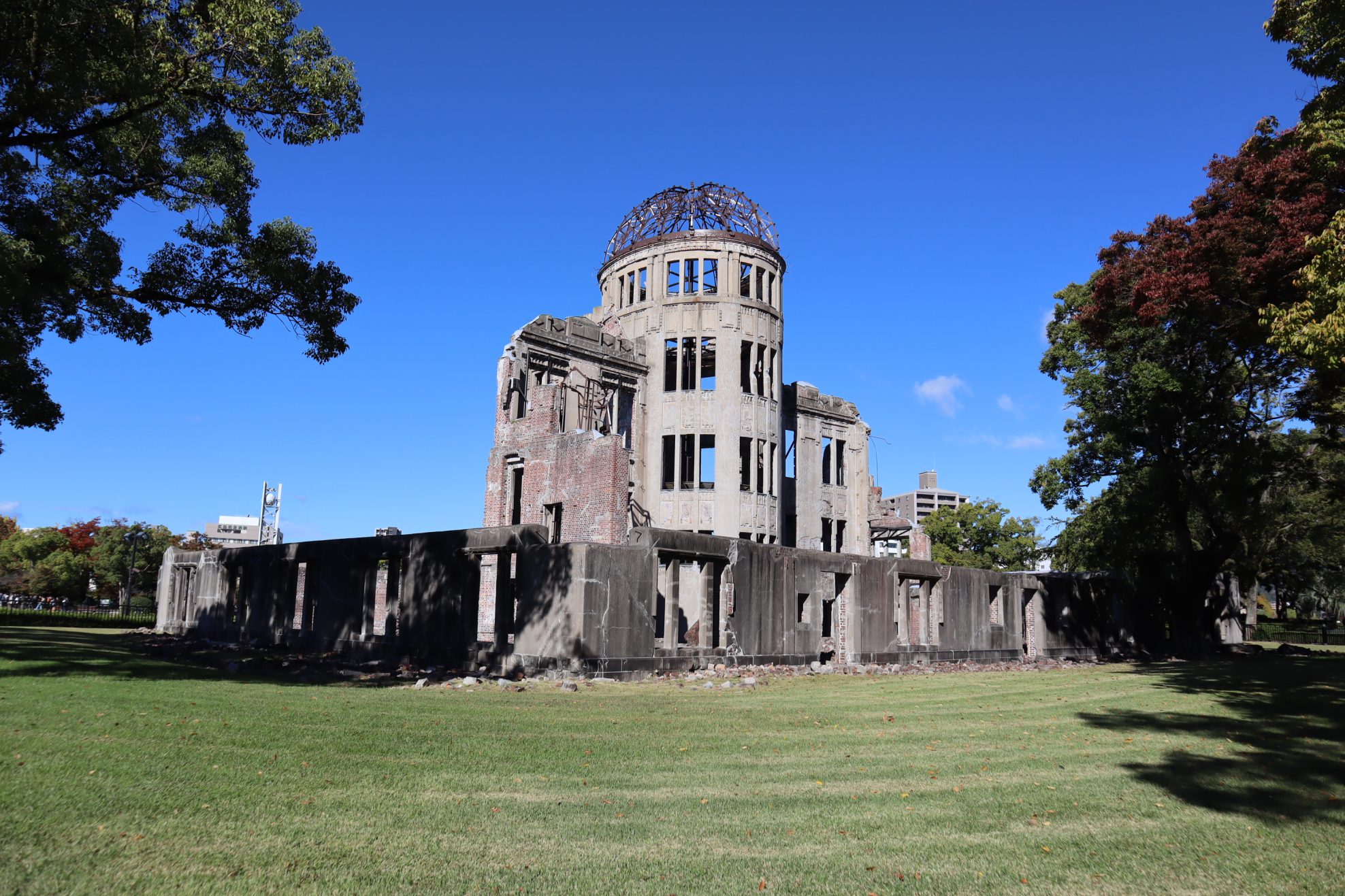
The Atomic Bomb Dome is just across the Motoyasu River. It survived because the bomb exploded almost directly above it, but it’s a ruin, left as it was that day as a reminder of the bomb. It’s illuminated after dark.
Peace Park forms the city’s heart. Ring the giant Peace Bell, which reverberates across the park. Walk up to the Cenotaph – a curved, concrete arch that frames the Flame of Peace – and read the names of those who died as a result of the bomb, then see thousands of colourful paper cranes folded by schoolchildren from around the world in the Children’s Peace Monument.
After the park, visit Orizuru Tower for a birds’ eye view of it or stroll along the path by the Motoyasu River towards Peace Boulevard.
A guide to Hiroshima Castle

While Hiroshima’s original castle was built in the 16th century, it was destroyed by the atomic bomb so the one you see today is a reconstruction.
Inside there’s a semi interesting museum exploring Hiroshima’s feudal history, and views of the moat and beyond. Take time to explore the grounds, stone gateways and castle walls.
Shukkeien Garden

If Peace Park tells Hiroshima’s modern story, Shukkeien Garden tells one that began four centuries earlier.
Created in 1620 for a feudal lord, the garden compresses mountains, valleys and forests into a landscape small enough to explore in an hour.
Sip matcha in the café, listen to the swish swish of a gardener’s bamboo broom as they sweep up leaves and admire the teahouse and stone bridge arching over the pond.
Hondori
Hondori is Hiroshima’s main shopping street. Covered from end to end, it stretches through the city centre beneath a glass roof.
It has few international brands; instead, it’s embellished with independent cafés and bakeries and shops selling records and clothes. Street musicians perform outside Parco at the eastern end.
Make time to explore the lanes that run parallel to it, too, which are bordered with coffee shops with five or six seats, second-hand bookshops and bars hidden behind unmarked doors.
Mitaki Temple

With more time, escape the city centre for Mitaki Dera (temple), which is 20 minutes away by train. Take the JR Kabe line from Hiroshima Station.
Nestled at the foot of a hill and surrounded by waterfalls, its stone lanterns and statues are shrouded in moss. A path weaves through cedar trees while wooden bridges arch over streams.
Mount Ogon

It only takes an hour to climb up to Mount Ogon above Hiroshima Station, yet most visitors ignore it. From the summit, you can see all of the city and beyond to the Seto Inland Sea.
A guide to Hiroshima’s art and culture scene
Hiroshima has a lively cultural scene. Hiroshima City Museum of Contemporary Art is among the best of its galleries. Hidden among trees on a hillside inside Hijiyama Park, it hosts temporary exhibitions by Japanese and international artists. The JMS Aster Plaza meanwhile hosts drama, dance and music.
Koganeyama (Ogonzan) Park

Hop in a taxi and you can wind up to this viewpoint south of Hiroshima City Museum of Contemporary Art.
Tetsuo adds, “It’s a scenic 50-minute hike to the summit (221m), from where you can enjoy a 360-degree view of Hiroshima and the Seto Inland Sea. Visit after dusk and you’ll also see Hiroshima Bridge and Kaita Bridge illuminated in orange.”
A guide to Hiroshima’s foodie scene

Okonomiyaki is Hiroshima’s signature dish. It’s often described like a pancake, but it’s closer to an inch-thick noodle omelette. Chefs crack an egg on a hotplate in front of you, smudge it into a thin omelette then add noodles, cabbage, bean sprouts and protein such as pork or prawns. Steam rises from the cabbage while the noodles crisp against the hotplate. Chefs drizzle mayonnaise and sweet and savoury okonomiyaki sauce on top and dust it with dried fish flakes and seaweed before serving it to you. Okonomimura houses 20 independent stalls across several floors. Each stall specialises in the dish but they’re all different. Some add oysters, others add cheese, kimchi or spicy noodles.
Tucked away on Hondori, Tsukiakari is my favourite restaurant. Hidden down an alleyway lit by paper lanterns, it feels traditional inside. Take off your shoes and sit on tatami mats, with your feet dangling in a hole beneath your table. The restaurant is known for another local dish – grilled eel – which is cooked over charcoal. The skin blisters, while the flesh stays soft. A glaze of soy, mirin and sugar caramelises on the surface.
Hiroshima produces more oysters than anywhere else in Japan. They’re best eaten in winter. Try them grilled over charcoal, deep fried, raw or folded into okonomiyaki. Look out for them in restaurants around Hondori; the nightlife district, Nagarekawa; or hand-sized ones on Miyajima, which come doused in citrusy yuzu juice.
If you’re craving ramen, seek out Bakudanya’s tsukemen – you dip the cold noodles in a spicy sauce.
A guide to Hiroshima’s café culture and comfort food

Independent cafés hide behind unmarked doors, inside renovated warehouses and along quiet riverside streets. Many roast their own beans. Others, such as Café Citron near Peace Boulevard, specialise in cherry blossom cheesecake and hand-drip coffee.
Even if you crave Japanese cuisine back home, at some point on your trip, you’ll probably get sick of it. That’s when you’ll want to stop by Namaste, which serves authentic Indian and Nepalese curry with naan puffed from the tandoor. For comfort food like burgers and pasta, visit New York, New York, behind Parco; order fish and chips or Sunday roast from the Irish pub Molly Malone’s or fajitas from Kemby’s – all expat-run institutions.
A guide to Hiroshima’s nightlife

Hiroshima comes alive after dark. Lanterns glow outside izakaya (Japanese pubs), karaoke blares on quiet streets and bars that seat up to 10 fill with conversation.
Nagarekawa near Parco is Hiroshima’s somewhat seedy entertainment district, but I always felt safe walking around it, even at night. If you can find it, stop by Stevie’s and say hello to the owner behind the bar, which is decorated like a piano.
In the streets parallel to Hondori you’ll find Kiss of Luminescence, a chic, dimly lit cocktail bar that plays jazz. Mac Bar is popular with expats and tourists. The walls are covered in graffiti (including mine!) and the owner has an encyclopaedic knowledge of music thanks to the hundreds of CDs behind the bar. Koba is another popular spot. Bom opened it three weeks after I moved to Hiroshima, and was still there when I popped in to say hi 20 years later.
A guide to Hiroshima’s accommodation: where should you stay in the city?
Hiroshima is compact, easily navigated on foot or by tram, so you can stay by Hiroshima Station or Peace Park.
The four-star Sheraton Grand Hiroshima Hotel is connected to Hiroshima Station, which is handy if you have an early Shinkansen train to catch.
If you prefer a boutique hotel, stay at The Knot Hiroshima on Peace Boulevard, close to Peace Park and Hondori. The four-star hotel has a ground floor restaurant, MORETHAN, which serves wood-fired pizza, and a rooftop restaurant and bar, Kei.
On a budget? Then book WeBase Hiroshima, a contemporary hostel with private rooms and dormitories resembling capsule hotels.
A 24-hour Hiroshima itinerary

If you’re travelling through Japan on a packed itinerary, one full day covers the main attractions. Start early to make the most of your day and to beat the crowds of schoolkids and tour buses that descend upon the Peace Memorial Museum. I suggest this itinerary:
7.30am Visit the Peace Memorial Museum, as soon as it opens
9.30am See the A Bomb Dome, Peace Park and Orizuru Tower
11.30am Unwind in a café along the river, then hop in a river boat from Motoyasu Pier
1pm Try eel dishes at Tsukiakari on Hondori
2.30pm See Hiroshima Castle, moat and grounds
4pm Meander around Shukkeien Garden
6pm Order okonomiyaki in Okonomimura
8pm Seek out Koba, Mac Bar or Kiss of Luminescence for drinks
A 48-hour Hiroshima itinerary

An extra day in Hiroshima will reveal a side to the city most tourists miss. It also allows for a night out in Nagarekawa without you worrying about missing your Shinkansen train to your next destination. On your second day I suggest this itinerary:
10am Explore Mitaki Temple, or climb up Mount Ogon then visit Hiroshima City Museum of Contemporary Art nearby
1.30pm Eat lunch around Hondori
3pm Browse the boutiques in the backstreets parallel to Hondori
6pm Eat dinner at MORETHAN in The Knot Hiroshima
9pm Go for drinks in Stevie’s in Nagarekawa, or take your chance on a random bar
A Miyajima day trip guide

You’ve surely already seen pictures of Itsukushima Shrine, a 12th century Shinto shrine that’s a UNESCO World Heritage Site. Surrounded by water when the tide is in, its red torii gate is one of Japan’s most photographed landmarks. Gojūnotō, a five-storey pagoda, sits on the hill above it, close to Senjokaku Pavilion, a vast wooden hall with views across the island.
Omotesandō is a pedestrianised lane packed with shops selling oysters, okonomiyaki and yuzu honey drinks.
Follow signs for the cable car and you’ll see wild deer; a red, humped wooden bridge; and a picturesque tearoom beneath maple trees in Momijidani Park. Take the cable car to the top of the mountain and hike back down.
If possible, build a night on Miyajima into your itinerary. Once the last ferry has departed and shopkeepers have drawn their shutters, lights flicker on in the stone lanterns on the seaside promenade. After soaking in an onsen (hot mineral bath), locals and overnight guests meander along the seafront in yukata and geta (wooden flip flops) crunching along the gravel path.
Book a ryokan, or traditional inn, such as Iwaso. Established in 1854, it features tatami mat rooms overlooking a tranquil maple forest.
To get to Miyajima, take a boat direct from the Peace Park or the JR Sanyo Line from Hiroshima Station to Miyajimaguchi Station (about 25-30 minutes). From the station, it’s a few minutes’ walk to the ferry terminal. Hop on the JR Miyajima Ferry or Matsudai Ferry – both take 10 minutes to Miyajima.
How to support Hiroshima

If, like me, you feel a connection with Hiroshima during your visit and want to support the city and its citizens, consider donating to Hiroshima Peace Culture Foundation. The organisation preserves the Peace Memorial Museum, peace education and cultural initiatives.
The City of Hiroshima also accepts donations that support peace initiatives and the preservation of the Atomic Bomb Dome.
If you’d like to start your own blog and want some writing tips, read my post on how to link paragraphs to make a story flow smoothly.
And if you found this guide to Hiroshima useful, please share it on social media.